

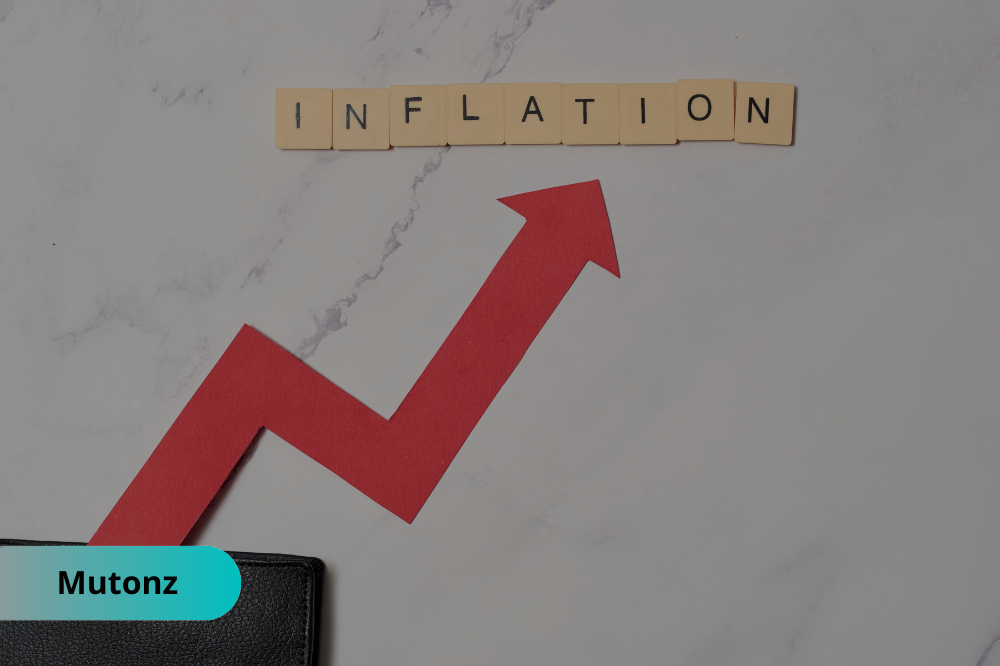
Learning how to protect savings from inflation is essential if you want your money to maintain its purchasing power over time. Even when inflation seems modest, rising prices gradually reduce what your savings can buy if they don't grow at a similar pace.
The good news is that you don't need complicated investments to reduce inflation's impact. In this guide, you'll learn why inflation matters, which savings and investment options may help, and how to choose an approach that fits your financial goals.
Why does inflation reduce the value of your savings?
Inflation measures how quickly the prices of goods and services increase over time.
When your savings earn less than the inflation rate, your purchasing power gradually declines. Your account balance may increase, but it may not increase enough to keep up with higher prices.
For example, imagine inflation averages 3% per year while your savings earn only 1%. Although you have more money in your account, that money buys fewer goods and services than it did a year earlier.
That is why financial professionals often focus on your real return, which measures your investment performance after accounting for inflation.
Is keeping cash the safest option?
Keeping money available for emergencies is always important.
However, leaving all of your savings in a checking account or holding large amounts of cash for many years can make inflation more expensive over time.
Many financial planners recommend keeping an emergency fund in a safe, accessible account while investing money intended for medium- and long-term goals in assets that have the potential to outpace inflation.
The right strategy depends on your financial goals, your investment timeline, and the level of risk you feel comfortable taking.
Accounts that may help protect your savings
Several financial products can help you protect savings from inflation, although each one offers different levels of risk, liquidity, and potential return.
High-yield savings accounts
High-yield savings accounts usually pay significantly higher interest than traditional savings accounts.
While their rates do not always exceed inflation, they can reduce its impact while keeping your money readily available. At eligible financial institutions, these accounts also qualify for FDIC insurance within applicable coverage limits.
Certificates of Deposit (CDs)
Certificates of Deposit often provide fixed interest rates that exceed those offered by standard savings accounts.
They work best for money you won't need right away because withdrawing funds before the maturity date may result in an early withdrawal penalty.
When interest rates are favorable, CDs can preserve purchasing power more effectively than low-interest deposit accounts.
Treasury Inflation-Protected Securities (TIPS)
TIPS are U.S. Treasury securities specifically designed to help investors manage inflation.
Their principal adjusts according to changes in the Consumer Price Index (CPI). As inflation rises, the value of the investment increases, and future interest payments rise as well.
Because the U.S. government backs these securities, many investors consider them one of the most direct ways to reduce long-term inflation risk.
Diversified investment portfolios
Stocks, mutual funds, and exchange-traded funds (ETFs) carry investment risk, but they have historically delivered stronger long-term returns than cash over extended periods.
A diversified portfolio spreads investments across different asset classes, helping reduce risk while increasing the potential to outperform inflation over time.
Should you invest instead of keeping everything in savings?
For money you may need soon, a savings account or high-yield savings account can still make sense.
However, if you're saving for goals that are several years away, investing may provide a better opportunity to protect savings from inflation over the long term.
Historically, diversified investments have generated higher returns than cash over extended periods, although they also involve market risk and periods of short-term volatility.
The longer your investment horizon, the more time your money has to recover from market fluctuations and potentially outpace inflation.
Common mistakes that make inflation more expensive
Many people lose purchasing power without realizing it because they make a few common financial mistakes.
Some of the biggest ones include:
- keeping all savings in a low-interest checking account;
- ignoring inflation when setting savings goals;
- investing too conservatively for long-term objectives;
- chasing unusually high returns without understanding the risks;
- failing to review savings and investments as interest rates change.
Avoiding these mistakes can make a meaningful difference over time, especially during periods of persistent inflation.
How to build an inflation-resistant savings strategy
There is no single solution that works for everyone.
Instead, many financial professionals recommend combining different types of accounts based on when you expect to use the money.
For example, you might consider:
- keeping emergency savings in a high-yield savings account;
- using CDs for money you won't need for several months or years;
- adding TIPS if inflation protection is a priority;
- investing long-term savings in a diversified portfolio of stocks and bonds.
This approach balances accessibility, stability, and long-term growth instead of relying on a single financial product.
Why diversification matters
One of the simplest ways to reduce financial risk is diversification.
Rather than relying on one account or one investment, diversification spreads your money across different asset classes that may perform differently under changing economic conditions.
For example, when inflation rises, some investments may struggle while others perform relatively well. Holding a mix of assets can reduce the impact of market swings and create a more balanced long-term strategy.
Diversification cannot eliminate investment risk, but financial experts widely consider it one of the most effective ways to manage uncertainty over time.
Focus on purchasing power, not just your account balance
Many people assume their savings are growing simply because the account balance increases every year.
In reality, what matters most is how much your money can actually buy in the future.
Learning how to protect savings from inflation means looking beyond interest rates and choosing a strategy that matches your goals, time horizon, and risk tolerance. By reviewing your savings regularly, comparing available financial products, and maintaining a diversified approach, you can improve your chances of preserving your purchasing power for years to come.
 Joint Bank Account: Pros, Cons, and When It Makes Sense
  The Hidden Costs of Homeownership in 2026
  What Is a Secured Loan and How Does It Work?